Semantic Segmentation for Pixel-Wise Visualization of Breast Cancer in Deep Ultraviolet-Excited Fluorescence Images
概要
Microscopy with ultraviolet surface excitation (MUSE) enables rapid fluorescence imaging of tissue surfaces, but MUSE images differ markedly from conventional hematoxylin and eosin images, making cancer delineation challenging for routine pathological practice. We investigated the feasibility of deep learning-based semantic segmentation, which assigns a class label to each pixel, for pixel-wise breast cancer detection in MUSE images. Fresh breast tissues from 30 mastectomy patients with breast cancer were stained with terbium and Hoechst and imaged by MUSE. A total of 150 cancerous images (five per case) were manually annotated into cancerous and non-cancerous classes, and 300 non-cancerous images (ten per case) were collected. Models were trained and evaluated using five-fold nested cross-validation, comparing a cancer-only (CO) model trained solely on cancerous images with a cancer plus non-cancer (CN) model trained on both cancerous and non-cancerous images. The CO model achieved a higher Dice score than the CN model (CO, 0.7478; CN, 0.7343). Sliding window-based majority voting post-processing reduced scattered false-positive areas and improved Dice scores (CO, 0.7984; CN, 0.7849). These results support the feasibility of deep learning-based semantic segmentation for visualizing breast cancer regions and provide a basis for future quantitative applications using MUSE images.
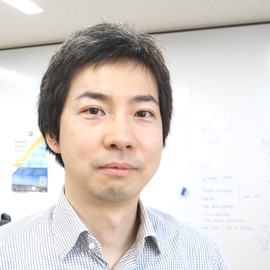
新岡宏彦
招へい准教授
深層学習による様々なバイオイメージングデータの分類、医療データを用いた診断補助に従事。光学顕微鏡(蛍光顕微鏡、第二近赤外顕微鏡、ラマン顕微鏡など)によるデータベース作成と分類。CT画像やヘルスケアデータを扱う。
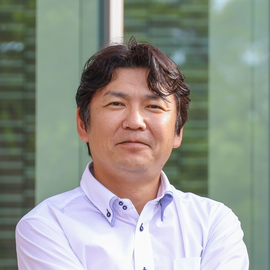
長原一
教授
コンピューテーショナルフォトグラフィ、コンピュータビジョンを専門とし実世界センシングや情報処理技術、画像認識技術の研究を行う。さらに、画像センシングにとどまらず様々なセンサに拡張したコンピュテーショナルセンシング手法の開発や高次元で冗長な実世界ビッグデータから意味のある情報を計測するスパースセンシングへの転換を目指す。